

“To work with the chakras is to heal ourselves of old constricting patterns.” (Anodea Judith)
Have you ever felt a lump in your throat when you couldn’t say what you needed to say? Or a flutter in your belly before a big decision, or a wwarmth spreading across your chest when someone you love walks into the room? Most of us have in fact, we have common expressions to describe these sensations such as “gut feelings,” being “heartbroken,” “choking up,” or feeling “grounded.” These common sensations are pointing to something deeper happening within us and long before modern science had names for the nervous system, the yogis of ancient India noticed these same places in the body and mapped them. They called them chakras.
Picture seven spinning wheels of light rising along your spine, from the deep red of the earth at its base to a violet glow at the crown of your head. Together they form a kind of inner rainbow, and each color tells part of your story. How safe you feel. How freely you create. How brightly you shine. How deeply you love. How clearly you speak. How much you trust your inner knowing. And how connected you feel to Source.
This guide started as a Starlight House offering for the National Charity League as a Mother/Daughter gathering to introduce the chakras and then have a felt sense of them through sound and a guided meditation. When it was over, so many of you asked for the teachings that we decided to gather them all in one place, and then keep going. What you’ll find here goes deeper than a handout ever could: where the chakra system comes from, how energy is said to move through the body, and why certain centers get “stuck.”

Mother Daughter Event for National Charity League (NCL) with The Starlight House
Whether you’re brand new to energy work or coming back to deepen a practice you already love, think of this as your complete guide to the 7 chakras. For each one, you’ll learn what it governs, how to tell when it’s out of balance, and simple, beautiful practices to help it open, flow and spin freely again. Take your time with it. Bookmark it. Come back to the chakra that’s calling you this week.
In this guide: What the chakras are · A brief history · How energy moves through the body · Why chakras become blocked · How to check in with your chakras · The 7 chakras at a glance · Root · Sacral · Solar Plexus · Heart · Throat · Third Eye · Crown · A 15-minute balancing ritual · Chakra work for mothers and daughters · FAQ
What Are the Chakras?
The chakras are energy centers in the body, described in ancient yogic philosophy as spinning wheels of life force. There are seven main chakras, running along the spine from its base to the crown of the head, and each one is linked to certain organs, emotions and areas of life.
The word chakra is Sanskrit for “wheel,” and that’s exactly how the ancient seers described what they sensed: spinning wheels, or vortices, of energy. If you’ve ever watched water swirl down a drain or leaves circle in a gust of wind, you have a feel for the image. Energy isn’t sitting still in these places. It’s moving, gathering and radiating outward.
What keeps the wheels turning is prana, the life force that animates every living thing. In Chinese medicine, the same idea is called chi or qi. You take in prana with your breath, your food, sunlight, time in nature and even the company you keep, and it circulates through the body along subtle pathways. The chakras are where that flow gathers and concentrates.
One helpful way to picture a chakra is as a point of intersection, a kind of busy crossroads where your body sends and receives information to and from your electromagnetic field. That field is also called the aura, or the subtle energy body. So each chakra is a meeting place between the physical you and the energetic you. What happens in one shows up in the other.
To be clear, you won’t find a chakra on an X-ray. The chakras aren’t anatomical organs like your heart or liver. Still, it’s striking that these hubs of energy sit near major nerve bundles and endocrine glands. The heart chakra sits near the thymus, the throat chakra near the thyroid, and the root chakra is paired with the adrenal glands, which drive the body’s fight-or-flight response. Many traditions teach that the chakras influence the health and function of the organs around them, which is why chakra work so often touches both body and mood at once.
A Brief istory of the Chakra System
The chakras have a longer and more interesting history than most wellness articles let on, and knowing a little of it makes the practice richer.
 The word chakra appears in India’s oldest sacred texts, the Vedas, where it mostly means a wheel, including the wheel of a chariot and the wheel of time. Over many centuries, the idea turned inward. In the tantric and yogic traditions of medieval India, teachers began describing the body as a living temple, with wheels or lotuses of energy stacked along its central channel. Different schools counted them differently. Some described five, some six, some more. The seven-chakra map most of us know today was set down in a Sanskrit text called the Sat-Cakra-Nirupana (“Description of the Six Centers”), written in 1577 by the Bengali teacher Purnananda. It describes six chakras along the spine plus the thousand-petaled lotus at the crown.
That text reached the Western world in 1919, when Sir John Woodroffe, writing as Arthur Avalon, translated it in his book The Serpent Power. From there, the chakras traveled through the Theosophical movement, into the work of psychologists like Carl Jung, and eventually into the yoga studios, sound healing rooms and meditation circles of today. Teachers such as Anodea Judith, whose words open this guide, went on to connect each chakra to stages of human development and psychology, which gave the ancient map a very modern usefulness.
Here’s a detail that surprises many people: the rainbow color scheme, with red at the root and violet at the crown, is a fairly recent addition. It was popularized in the West in the 1970s. The older Sanskrit texts give the chakras different colors and describe each as a lotus with its own number of petals, its own geometric shape and its own animal. We’ve included those traditional petal counts in each chakra’s section below, because they add a lovely layer of meaning. The rainbow system has stuck around for good reason, though. It’s easy to remember, easy to visualize, and it mirrors the way light itself moves from slow, dense red to fast, fine violet.
So when you work with the chakras, you’re drawing on a living tradition. It’s centuries old, it has changed with every culture that has loved it, and it’s still growing.
 How Energy Moves Through the Body
The Sushumna: Your Energetic Superhighway
The seven main chakras are strung like beads along a vertical column of energy called the sushumna. It runs along the spine from its base all the way to the crown of the head. The sushumna is often described as the superhighway that energy and consciousness travel to inform the body. When the chakras along it are clear and spinning freely, life force moves up and down this channel with ease, the way traffic flows on an open road.
The sushumna isn’t the only road, though. Yogic texts describe as many as 72,000 nadis, or subtle energy channels, running through the body like rivers and streams. Two of them matter most in chakra work. The ida, linked to the moon and to cool, receptive, feminine energy, begins on the left side. The pingala, linked to the sun and to warm, active, masculine energy, begins on the right. These two wind around the sushumna in a double spiral, crossing at the chakras. If you’ve ever seen the caduceus, the staff with two snakes coiled around it, you’ve seen a picture of this very idea.
When the ida and pingala are in balance, we feel both calm and energized, receptive and able to act. Simple breathing practices like alternate nostril breathing (nadi shodhana) are designed to bring these two currents into harmony.
Kundalini: The Energy Waiting at the Root
Many traditions describe a dormant energy resting at the base of the spine called kundalini. It’s often pictured as a serpent coiled three and a half times around itself, sleeping at the root chakra. Through practices like breathwork, meditation, yoga, and chanting, this energy is said to awaken and rise up the sushumna, moving through each chakra in turn until it reaches the crown. Classic yogic texts describe that rising as a gradual awakening of consciousness.
You don’t need to chase a dramatic kundalini experience to benefit from chakra work. Most of the real change happens quietly: a little more ease in the body, a little more honesty in your voice, a little more trust in your intuition. But it helps to know the bigger picture. The chakras aren’t separate boxes. They’re stations along one living current that runs through all of you.
How Your Thoughts Shape Your Energy
Our thoughts, our feelings and the way we frame our experiences all determine how well each wheel spins. When we carry a worry for weeks, hold back words we need to say, or tell ourselves the same painful story over and over, the energy in the related chakra can slow down and grow heavy. Over time, a stagnant or blocked chakra may show up as physical tension or discomfort, and it can affect our overall sense of well-being.
The relationship runs both ways, and this is the part many people find eye-opening. The health of our chakras also shapes how we perceive what happens to us. When a chakra is out of balance, we may misread a situation and react from an old wound rather than from the truth of the present moment.
Here’s an example. Imagine someone with an unsettled root chakra, whose deepest sense of safety feels shaky. A friend texts to push their dinner plans back a week. For most people that’s a small change of plans. For this person, it can land as a threat to their security, a sign that they’re not wanted or can’t count on anyone. Nothing about the text changed. The lens did. That’s why chakra work isn’t only about feeling better in the body. It can change how you see your whole life.
Why Chakras Become Blocked
The shape and content of each chakra is formed largely by repetition. Think of it like a path through a field of tall grass: walk the same way enough times and a trail forms, and soon it’s the easiest way to go. Our energy works much the same way.
Many things leave their mark on our energy centers:
- Our day-to-day actions and habits
- The programming we absorbed from our parents and culture, often before we could even speak
- The body we were born into
- The circumstances of our lives, including the hard seasons
- And, many believe, the imprints of past lives
A chakra can become “stuck” when it keeps running the same pattern. We act in a familiar way, we get a familiar result, and the loop reinforces itself. Maybe you learned early that speaking up caused trouble, so you stay quiet, so no one knows what you need, so you feel unheard, so you stay quiet again. In yogic philosophy, this self-perpetuating cycle of action and result is part of what’s called karma. It isn’t a punishment. It’s more like momentum.
And momentum can change direction. A pattern that was learned can be unlearned, and energy that was held can be released. That’s the heart of chakra work: gently interrupting old loops and giving your energy a new, freer path to follow.
Underactive, Overactive and Balanced
It helps to know that a chakra can fall out of balance in two directions. An underactive chakra is closed or sluggish: too little energy moving through. An overactive chakra runs too hot: too much energy, often in the form of force, control or overwhelm. You’ll see both sides in the “Signs” lists below. For example, an underactive solar plexus might show up as self-doubt, while an overactive one tips into perfectionism or needing to control everything.
The goal is never to blast every chakra wide open. It’s balance: each wheel spinning at a healthy, steady pace, in harmony with the others.
How to Check In With Your Chakras
You don’t need special equipment to begin. You already have the most sensitive instrument there is, which is your own body. The practice is simply to tune into the area of a chakra and notice what’s there, without trying to fix anything yet.
Find a quiet moment, close your eyes (shutting down this dormant sense will allow you to feel more), and bring your attention to one area.
Then ask yourself:
- Is there tightness, heaviness, warmth, coolness or tingling?
- Does a certain emotion or memory come up when I bring my attention here?
- Does the area feel open and spacious, or guarded and closed?
These sensations are clues, and there are no wrong answers. Some days your heart will feel wide open and your throat will feel tight. Other days it’ll be the reverse. Over time you’ll start to notice your own patterns, and that awareness is already healing.
Once you know where to focus, you can choose from a whole palette of tools to nourish and move energy in that center: yoga postures, breathwork, meditation, visualization, color, crystals, essential oils and, one of our favorites at The Starlight House vibe sessions. Because each chakra is traditionally paired with its own seed sound, sound is one of the most direct ways to reach it. You can literally feel it vibrate. Alternatively, if you are concerned or having a hard time feeling your chakras a bio-well scan is the perfect way to gain a deeper snapshot into how energy may be traveling or stuck in the body.
How the Chakras Work Together: Two Triangles and the Heart
 The seven chakras are often grouped into two triangles joined at the heart. It’s a helpful map for understanding how the whole system fits together
- The lower triangle (chakras 1 to 3):root, sacral and solar plexus. These are the chakras of the physical and personal self: survival, pleasure and personal power. They ground us in the body and in the material world, and they’re about how we take care of ourselves.
- The heart chakra (chakra 4): The bridge. The heart is the point of balance between the two triangles. This is where experience shifts from “me” to “thee” and “we.”
- The upper triangle (chakras 5 to 7): throat, third eye and crown. These are the chakras of expression, insight and spiritual connection, and they’re about how we relate to something larger than ourselves.
Fittingly, the traditional symbol of the heart chakra is a six-pointed star made of two interlaced triangles, one pointing up and one pointing down. It’s the meeting of earth and spirit drawn in a single shape.
There’s a beautiful flow between the two triangles. Our ideas and inspirations descend from the upper chakras, filter through the heart, and move down into the lower chakras, where they become something solid and tangible in our lives. A vision (third eye) becomes words (throat), is warmed by love (heart), gathers willpower (solar plexus), creative juice (sacral) and practical resources (root), and becomes real. Energy also rises from the root toward the crown as we grow in awareness. A healthy system lets energy move freely in both directions, up and down, like breathing.
The 7 Chakras at a Glance: Meanings, Colors and Sounds

Save this chart as your quick reference to chakra meanings, colors, elements and sounds.
1. Root Chakra (Muladhara): Safety, Security and Survival
The root chakra is the foundation of your entire energetic system. Muladhara means “root support,” and that’s exactly its job. It represents stability, security and our most basic needs: food, shelter, money and belonging. When the root chakra is open and balanced, you feel safe, grounded and fearless, at home in your body and on the earth.
Think about how a tree works. The taller it wants to grow, the deeper its roots need to go. The same is true for us. It’s hard to open your heart or trust your intuition when some part of you is quietly worried about survival. That’s why so many teachers say to start here.
Red carries the longest wavelength and slowest vibration of the visible light spectrum, which makes it the perfect color for this dense, grounding center. In the traditional texts, Muladhara is drawn as a lotus with four petals around a square, the shape of the earth element, and it’s home to the sleeping kundalini energy.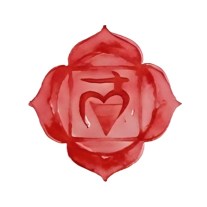
Color: Red
Element: Earth
Seed sound: LAM
Musical note: C
Location: Perineum, base of the spine
Function: Survival and grounding
Body areas: Legs, feet, bones, large intestine
Gland: Adrenals
Traditional petals: 4
Signs Your Root Chakra Is Out of Balance
- Persistent worry about money, housing or having enough
- Feeling anxious, restless or “ungrounded,” like you’re floating above your life
- Difficulty trusting, or a constant sense that the rug could be pulled out from under you
- Clinging tightly to possessions, routines or control. Or the opposite: struggling to commit, settle or care for your basic needs
- Physical signs often linked to this center: tension in the legs, knees or feet, lower back or sciatic discomfort, sluggish elimination, and changes in appetite or weight
Practices to Balance and Open the Root Chakra
- Yoga: Warrior II (Virabhadrasana II). Press firmly through both feet and feel your legs as roots. Mountain Pose, Garland Pose and Legs-Up-the-Wall are also grounding.
- Earthing: Walk barefoot on grass, soil or sand. Sit with your back against a tree.
- Sound: Chant LAM slowly and deeply, or work with tones pitched to the note C. Drumming is especially grounding.
- Visualization: Imagine a glowing red root extending from the base of your spine deep into the earth, anchoring you.
- Nourishment: Warm, hearty root vegetables, beets and red foods.
- Crystals and scents: Red jasper, hematite, smoky quartz and black tourmaline; vetiver, cedarwood or patchouli oil.
- Affirmation: I am safe. I am supported. I belong here.
2. Sacral Chakra (Svadhisthana): Creativity, Pleasure and Flow
The sacral chakra is your center of creativity, sensuality and emotional flow. Svadhisthana is often translated as “one’s own place” or “dwelling place of the self,” which says a lot about how personal this center is. Its element is water, and like water, it asks to move. When the sacral chakra is open, you feel creative, passionate, playful and outgoing, able to enjoy life and let your feelings flow without being swept away by them.
If the root chakra is about surviving, the sacral chakra is about living. It’s the part of you that savors a good meal, loses track of time in a creative project, dances in the kitchen, and cries at a movie. It holds our relationship with pleasure, and for many women especially, that relationship comes with a lot of old messages about what’s allowed. Gentle attention here can be deeply freeing.
In the traditional texts, Svadhisthana is drawn as a lotus with six petals around a crescent moon, a nod to water and to the tides of emotion.
Color: Orange
Element: Water
Seed sound: VAM
Musical note: D
Location: Lower abdomen, genitals and womb
Function: Desire, pleasure, sexuality, procreation
Body areas: Womb, reproductive organs, kidneys, bladder, circulation
Glands: Ovaries, testes
Traditional petals: 6
Signs Your Sacral Chakra Is Out of Balance
- Feeling creatively blocked, flat or uninspired
- Difficulty feeling or expressing emotions, or emotions that feel overwhelming
- Numbing out through food, alcohol, shopping, screens or other compulsive habits
- Fear of betrayal, guardedness in intimacy, or reluctance to commit
- Guilt or shame around pleasure
- Physical signs often linked to this center: low back stiffness, menstrual or reproductive discomfort, low libido, and bladder or kidney sensitivity
Practices to Balance and Open the Sacral Chakra
- Yoga: Low Squat (Malasana). Let the hips open and breathe into the pelvic bowl. Hip circles, Pigeon Pose and Goddess Pose also help.
- Movement: Free-form dancing, belly dancing, or any flowing, sensual movement.
- Water: Take a ritual bath, swim, or sit by moving water. Drink plenty of water.
- Sound: Chant VAM with a soft, rolling tone, or work with tones pitched to the note D.
- Creativity: Paint, write, cook or craft with no goal other than joy.
- Nourishment: Oranges, mango, sweet potato, carrots and seeds.
- Crystals and scents: Carnelian, orange calcite and moonstone; sweet orange, ylang ylang or jasmine oil.
- Affirmation: I allow myself to feel. I create with joy. Pleasure is my birthright.
3. Solar Plexus Chakra (Manipura): Personal Power and Will
The solar plexus chakra is your inner sun, the source of your personal power, confidence and will. Manipura means “lustrous gem,” and there’s something about that name that fits: this is the place where you shine. When this chakra is balanced, you feel confident and self-directed, able to make choices, set boundaries and follow through on what matters to you.
Its element is fire, and fire transforms. Just as your digestive fire turns food into energy, the solar plexus turns intention into action. It’s the “I can” of the chakra system. You feel it when you finally say no to something that drains you, or when you start the project you’ve been putting off for a year.
Like any fire, it needs tending. Too little, and we feel powerless and small. Too much, and it burns through our relationships and our energy. In the traditional texts, Manipura is drawn as a lotus with ten petals around a downward-pointing triangle, the symbol of fire.
Color: Yellow
Element: Fire
Seed sound: RAM
Musical note: E
Location: Between the navel and the base of the sternum
Function: Will, power, self-esteem
Body areas: Digestive system, stomach, liver, muscles
Glands: Pancreas, adrenals
Traditional petals: 10
Signs Your Solar Plexus Chakra Is Out of Balance
- Low self-esteem, self-doubt or harsh inner criticism
- Feeling rejected, powerless or easily taken advantage of
- Trouble making decisions or following through
- On the other side: a need to control, perfectionism, anger, or burnout from pushing too hard
- Physical signs often linked to this center: a “knot” in the stomach, digestive upset, fatigue and blood sugar swings
Practices to Balance and Open the Solar Plexus Chakra
- Yoga: Boat Pose (Paripurna Navasana). Feel the fire building in your core. Twists, Plank and Warrior III also stoke this center.
- Breathwork: Breath of Fire (Kapalabhati), or long, slow belly breaths to calm an overactive fire.
- Sunlight: Spend time in the morning sun and imagine it filling your belly with golden light.
- Sound: Chant RAM with strength and clarity, or work with tones pitched to the note E.
- Empowerment practice: Make one small promise to yourself each day, and keep it.
- Nourishment: Bananas, lemons, yellow peppers, ginger, turmeric and whole grains.
- Crystals and scents: Citrine, tiger’s eye and yellow jasper; lemon, ginger or peppermint oil.
- Affirmation: I am worthy. I honor my power. I choose my path.
4. Heart Chakra (Anahata): Love, Forgiveness and Trust
The heart chakra is the bridge between the lower and upper triangles, the place where “me” becomes “we.” It governs love, compassion, forgiveness and trust, for others and for ourselves. When the heart is open, love flows in and out freely, and we can give and receive with equal grace.
Anahata means “unstuck” or “unhurt.” Some teachers link the name to the “unstuck sound,” a sound mediators describe hearing in deep stillness that isn’t made by any two things striking together. There’s something tender in that idea: that underneath every heartbreak, some part of your heart remains whole and unhurt.
Many of us have learned to love others well but struggle to extend the same kindness inward, or we give and give but find it hard to receive. A balanced heart chakra holds both directions. In the traditional texts, Anahata is drawn as a lotus with twelve petals around a six-pointed star, the two triangles of the chakra system joined as one. Alongside green, it’s often associated with soft rose pink, the color of tenderness, which is why roses feel like such a natural companion to heart work.

Color: Green (and soft rose pink)
Element: Air
Seed sound: YAM
Musical note: F
Location: Center of the chest
Function: Love, compassion, connection
Body areas: Heart, lungs, chest, arms and hands
Gland: Thymus
Traditional petals: 12
Signs Your Heart Chakra Is Out of Balance
- Fear of loneliness, or feeling disconnected even when surrounded by people
- Jealousy, resentment or bitterness that is hard to release
- Difficulty forgiving others or yourself
- Giving until you’re empty, or struggling to receive love and help
- Building walls to avoid being hurt again
- Physical signs often linked to this center: tightness in the chest, shallow breathing, rounded shoulders and tension in the upper back
Practices to Balance and Open the Heart Chakra
- Yoga: Camel Pose (Ustrasana), or for experienced practitioners, Full Wheel (Urdhva Dhanurasana). Supported Fish over a bolster is a gentle alternative.
- Breathwork: Slow, expansive breaths into the back and sides of the ribs.
- Loving-kindness meditation: Silently offer “May you be happy, may you be well” to yourself, a loved one, a stranger and someone you find difficult.
- Sound: Chant YAM softly, or work with tones pitched to the note F. Crystal singing bowls are especially heart-opening.
- Nature: Spend time among green, growing things. Tend a garden, or sit among the roses.
- Nourishment: Leafy greens, green tea, avocado, cucumber and herbs.
- Crystals and scents: Rose quartz, green aventurine and malachite; rose, geranium or bergamot oil.
- Affirmation: I give and receive love freely. I forgive. My heart is open.
5. Throat Chakra (Vishuddha): Voice, Truth and Expression
The throat chakra is the center of communication, self-expression and speaking your truth. Vishuddha means “purification,” and as the first of the upper chakras, it’s where we begin to give form to what we feel and know. When the throat chakra is open, you speak honestly and kindly, listen deeply, and express your creativity with confidence.
It makes sense that purification lives here. Everything we’ve felt in the heart and understood in the mind has to pass through the throat to be shared, and speaking the truth has a way of clearing the air, inside and out. Think of how much lighter you feel after an honest conversation you’d been dreading.
The throat chakra isn’t only about talking, though. Listening is half of communication, and so is silence. A balanced throat knows when to speak, when to listen, and when to simply let a moment be. Its element is ether, or space, which the old texts call the element of sound. In those same texts, Vishuddha is drawn as a lotus with sixteen petals around a circle like a full moon.
Color: Bright blue
Element: Ether (space), the element of sound
Seed sound: HAM
Musical note: G
Location: Throat
Function: Communication, expression, creativity
Body areas: Throat, neck, jaw, mouth, ears, shoulders
Glands: Thyroid, parathyroid
Traditional petals: 16
Signs Your Throat Chakra Is Out of Balance
- Holding back what you truly think or feel, or a sense of “swallowing your words”
- Fear of speaking up, being judged or not being heard
- Over-talking, interrupting or gossiping
- Difficulty listening, or saying yes when you mean no
- Physical signs often linked to this center: a tight or sore throat, jaw clenching, stiff neck and shoulders, and ear sensitivity
Practices to Balance and Open the Throat Chakra
- Yoga: Fish Pose (Matsyasana), which opens the front of the throat. Shoulder Stand, Plow and gentle neck rolls also help.
- Sound: Chant HAM, sing, hum or tone. Your own voice is the most powerful instrument for this center. Work with tones pitched to the note G.
- Journaling: Write unsent letters, and say what has been left unsaid.
- Truth practice: Each day, speak one honest, kind sentence you would normally hold back.
- Nourishment: Blueberries, warm herbal teas with honey, and plenty of water.
- Crystals and scents: Blue lace agate, aquamarine and sodalite; eucalyptus, peppermint or chamomile oil.
- Affirmation: My voice matters. I speak my truth with love.
6. Third Eye Chakra (Ajna): Intuition and Inner Sight
The third eye chakra is the seat of intuition, imagination and inner knowing. Ajna means “to perceive” or “command.” Traditionally considered a receptive, feminine center, it helps us see beyond the surface of things. When the third eye is open, you trust your intuition, see situations clearly, and can hold a vision for your life.
You already use this chakra more than you might think. It’s at work when you “just know” something before you can explain why, when a solution arrives in the shower, or when a dream stays with you all day because it seemed to be telling you something. The third eye speaks in images, symbols and quiet hunches rather than words.
In the traditional texts, Ajna is drawn as a lotus with just two petals. Many teachers read those two petals as the ida and pingala, the lunar and solar currents, finally meeting at the brow. It’s the place where opposites come together, so we can see the whole picture instead of just one side.
Color: Indigo
Element: Light
Seed sound: OM (some traditions use KSHAM)
Musical note: A
Location: Center of the forehead, between or just above the brows
Function: Seeing, intuiting, imagining
Body areas: Eyes, brain, sinuses
Gland: Pineal
Traditional petals: 2
Signs Your Third Eye Chakra Is Out of Balance
- Doubting or ignoring your intuition
- Moodiness, volatility or feeling lost in your thoughts
- Difficulty imagining a future or setting a vision
- Overthinking, or the opposite: getting lost in fantasy and losing touch with practical reality
- Physical signs often linked to this center: tension headaches, eye strain, restless sleep, and vivid or disturbing dreams
Practices to Balance and Open the Third Eye Chakra
- Yoga: Child’s Pose (Balasana), resting the forehead on the mat or a block. Dolphin Pose and Eagle Pose also focus this center.
- Meditation: Candle gazing (Trataka). Soften your gaze on a candle flame, then close your eyes and watch the afterimage.
- Sound: Chant OM with the sound vibrating in your head, or work with tones pitched to the note A.
- Light and sound journeys: Brainwave entrainment and light therapy, like our Vibe Sessions, invite the mind into deep, dreamlike states where intuition speaks.
- Dream journaling: Keep a notebook by your bed and record your dreams on waking.
- Nourishment: Purple and dark blue foods such as blackberries, purple grapes and eggplant.
- Crystals and scents: Amethyst, lapis lazuli and labradorite; frankincense, clary sage or lavender oil.
- Affirmation: I trust my inner knowing. I see clearly.
7. Crown Chakra (Sahasrara): Spiritual Connection and Awakening
The crown chakra is our gateway to higher consciousness, spiritual connection and awakening. Sahasrara means “thousand-petaled,” and it’s often pictured as a lotus of a thousand petals opening at the top of the head. When the crown is open, we feel connected to something greater than ourselves, with a sense of meaning, peace and oneness.
Traditionally considered a masculine, radiant center, the crown complements the receptive third eye. Yogic teachings describe the meeting of the pituitary and pineal energies in the “cave of Brahma” as the opening of the crown to higher consciousness. In the kundalini tradition, this is where the rising energy finally arrives, and the journey that began at the root comes home.
The number one thousand isn’t meant to be counted. It’s a way of saying “limitless.” The crown is less a place you get to than a quality of awareness you settle into: the quiet sense, maybe while watching a sunset or holding a newborn, that you’re part of something vast and good. You may not live there all the time. None of us do. But each glimpse changes you a little.
Color: Violet or white
Element: Thought (pure consciousness)
Seed sound: Silence, or a soft OM
Musical note: B
Location: Top of the head
Function: Understanding, spiritual connection
Body areas: Cerebral cortex, central nervous system
Gland: Pituitary (some traditions pair the crown with the pineal)
Traditional petals: 1,000
Signs Your Crown Chakra Is Out of Balance
- Feeling disconnected from purpose, meaning or spirit
- Confusion, apathy or boredom with life
- Closed-mindedness, rigid beliefs or prejudice
- Fear of alienation, or feeling alone in the universe
- On the other side: spiritual bypassing, or living “in the clouds” and neglecting the body and daily life
- Physical signs often linked to this center: mental fog, low energy, and heightened sensitivity to light and sound
Practices to Balance and Open the Crown Chakra
- Yoga: Headstand (Salamba Sirsasana) for experienced practitioners. Gentler options include Rabbit Pose, Supported Headstand prep, or simply resting in Savasana with full awareness.
- Silent meditation: Sit in stillness and rest as the awareness behind your thoughts.
- Sound: Rest in silence, or listen to tones pitched to the note B and high, shimmering crystal bowls.
- Prayer and gratitude: Begin or end each day with a moment of thanks.
- Nature: Watch the sunrise, or lie beneath the stars. Arizona’s night sky is a gift for this practice.
- Nourishment: The crown is fed less by food and more by fasting from noise. Take a digital detox, breathe fresh air and bask in sunlight.
- Crystals and scents: Clear quartz, amethyst and selenite; lotus, frankincense or sandalwood.
- Affirmation: I am connected to the Divine. I am one with all that is.
A 15-Minute Chakra Balancing Ritual
You don’t need to work on every chakra every day. Most of the time, it’s enough to tend the one that’s asking for attention. But now and then it feels good to tune the whole instrument, the way a musician tunes every string before playing. This simple ritual moves energy through all seven centers, and it’s a lovely way to start a morning or wind down before sleep.
- Arrive. Sit or lie comfortably. Take three slow breaths, lengthening each exhale.
- Ground. Bring your awareness to the base of your spine. Imagine red light and roots reaching into the earth. Chant LAM three times.
- Rise through each center. Move your attention up one chakra at a time. At each one, picture its color glowing and spinning, and chant its seed sound three times: VAM (orange, lower belly), RAM (yellow, solar plexus), YAM (green, heart), HAM (blue, throat), OM (indigo, brow).
- Open the crown. At the top of your head, rest in silence. Imagine violet-white light pouring in and flowing down through every center.
- Notice. Scan from crown to root. Which center felt bright? Which felt quiet or heavy? That’s where your attention wants to go this week.
- Seal. Place your hands on your heart and belly. Offer a word of gratitude.
If chanting feels unfamiliar or a little awkward at first, that’s completely normal. You can simply hum, or listen to a chakra sound bath and let the tones do the work. The vibration matters more than getting the sounds “right.” Have more time? Lie down or grab a comfortable seat and take our 30- minute chakra guided meditation and sound bath. This immersive journey will help you to connect and feel into your own energetic centers.
Chakra Work for Mothers and Daughters
Many of the patterns held in our chakras were learned at home. The way our mothers spoke about money, bodies, pleasure, anger and love shaped our own energy, and the way we speak shapes our daughters’. Most of it was never said out loud. It was absorbed at the kitchen table, in the car, in the way someone sighed or smiled or went quiet.
That’s why chakra work between mothers and daughters can be so tender and so healing. It gives two generations a shared language for what they feel. Instead of “you never listen to me,” you can say “my throat chakra feels really tight right now.” It sounds simple, but it opens a door.
How the Chakras Grow With Us
Anodea Judith, whose work helped bring the chakras into modern psychology, describes the chakras as developing roughly in order through childhood. In her model, the root forms from the womb through the first year of life, when a baby learns whether the world is safe. The sacral chakra follows in the toddler years, with the discovery of feeling and pleasure. The solar plexus comes next, in the “I can do it myself!” stage. The heart opens in early childhood, as children learn to care about others. The throat develops through the school years, the third eye through adolescence, and the crown continues to unfold throughout our lives.
For mothers, this can be a powerful lens. The seasons of your daughter’s childhood were, in a sense, seasons of chakra-building. And your own chakras were shaped in your own mother’s home. None of this is about blame. It’s about seeing the thread that runs through the generations and choosing, together, what you’d like to carry forward.
A Mother/Daughter Chakra Practice
Try this together:
- Sit facing each other, knees close, hands resting palms up.
- Breathe together for one minute, letting your breath find a shared rhythm.
- Journey through the chakras using the ritual above, chanting each seed sound together. Notice how your voices blend.
- Share one word for each chakra: how it feels for you right now. There’s no right answer.
- Offer a heart blessing. Place a hand on each other’s heart and take turns speaking one thing you appreciate about the other.
- Close with a hug held long enough for three full breaths.
Conversation Prompts for Afterward
- Root: What helps you feel safe? What did “home” feel like growing up?
- Sacral: What brings you joy or makes you feel most creative?
- Solar plexus: When do you feel most confident?
- Heart: How do you like to receive love?
- Throat: Is there something you’ve wanted to say to me?
- Third eye: What is your intuition telling you right now?
- Crown: What makes you feel connected to something bigger?
Frequently Asked Questions About the Chakras
How many chakras are there?
Most modern teachings focus on seven main chakras along the spine, from the root to the crown. Older texts sometimes counted differently, and many traditions also describe minor chakras in the hands and feet, along with energy centers above the head and below the feet.
Where do the chakra colors come from?
The familiar rainbow colors, red at the root through violet at the crown, were popularized in the West in the 1970s. Older Sanskrit texts describe each chakra as a lotus with its own colors, petals and symbols. Both systems are in use today, and the rainbow version is the easiest to visualize.
What is kundalini?
Kundalini is described in yogic tradition as a dormant energy coiled at the base of the spine, in the root chakra. Through practices like breathwork, meditation and chanting, it’s said to rise through the chakras toward the crown, bringing a gradual awakening of consciousness.
How do I know if my chakras are blocked?
Pay attention to recurring emotional patterns and where you hold tension in your body. Use the “Signs” lists in each chakra section above as a guide. A Bio-Well energy scan can also offer a visual snapshot of your stress levels, energy flow and chakra balance.
Which chakra should I work on first?
Start with the root. A stable foundation supports everything above it. After that, follow the center that feels most tender or most alive for you right now.
Can sound really help balance the chakras?
Sound has been used for healing in nearly every culture. Each chakra is traditionally paired with a seed sound and a musical note, and many people find that chanting, singing bowls and vibroacoustic sound, like vibe sessions, can help them feel more relaxed, present and in tune.
How long does it take to balance a chakra?
Some shifts are felt in a single session. Deeper patterns loosen over weeks and months of gentle, consistent practice. Be patient and kind with yourself.
What is the difference between an open and an overactive chakra?
An open, balanced chakra spins freely. An underactive chakra feels closed or sluggish, while an overactive one runs too hot, for example a solar plexus that tips from confidence into control. Balance, not maximum openness, is the goal.
Experience Chakra Balancing at The Starlight House
Reading about the chakras is a beautiful beginning. Feeling them is something else entirely. There’s a moment in a vibe session when a tone lands right in your chest and something lets go. No article can give you that.
At The Starlight House in Paradise Valley, we pair ancient practices with modern-day technologies to attune your frequency and invite the body into its natural self-healing rhythm. Serving Scottsdale, Arcadia, Phoenix and Sedona, we offer:
- Vibe Sessions: Immerse yourself in sound and light on our custom vibroacoustic sound bed. Brainwave entrainment and healing frequencies help recalibrate your nervous system and awaken your inner sight. Book Now
- Bio-Well Sessions: See your energy. A personal energy scan shows your stress levels, energy flow and chakra balance, so you know exactly where to focus. Book Now
- Bio-Well Scan & Vibe: See your energy and get the exact sound prescription you need to balance your chakras. After your Bio-Well scan vibe to a sound bath created from your energy scan. You’ll leave with a full report and sound file to continue your work at home. Book Now
- Temple of the Rose: Come settle in with community into our outdoor ceremonial space, a sanctuary for embodied awakening and the heart of our seasonal gatherings and circles. Guided meditation, soulful sound and meaningful ritual to get in touch with your interior landscape.
- Day Retreats and the Resonance Circle: Deepen your practice with one-on-one or couple retreats. Think workshop meets relaxation. Book our Understanding the Chakras Retreat to dive into deeper understanding. Book a Day Retreat. Book a Day Retreat for Two.

Kim Roach, Owner of The Starlight House, using sound before a vibe session.
Come not to perform, but to feel.
Still don’t know where to begin? Schedule a free 15-information call now to get your started.
The information in this article is for educational and spiritual wellness purposes and is not a substitute for medical advice, diagnosis or treatment. Please consult a qualified healthcare provider for any physical or mental health concerns.